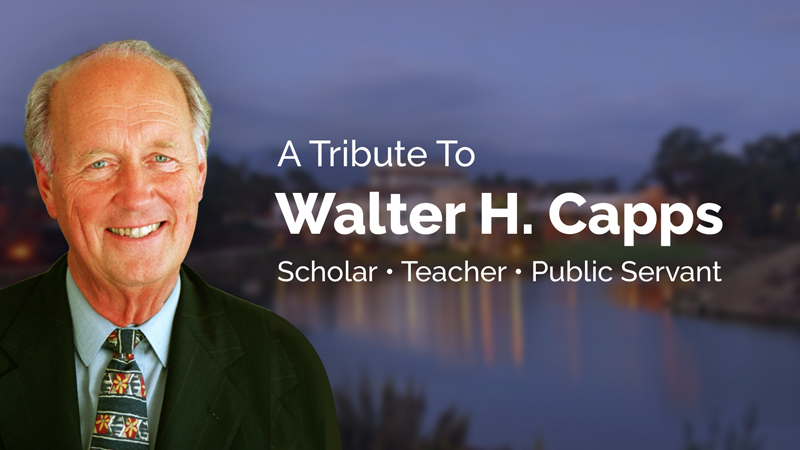
Walter H. Capps, who spent his career bringing people—students, veterans, scholars, public officials, and community members—into conversation, is the subject of a new documentary. A professor of religious studies at UC Santa Barbara, he believed that thoughtful dialogue could connect academic ideas with the challenges of public life.
Capps helped shape the field of religious studies at UCSB and became known for an approach grounded in empathy and openness to different perspectives. His interest in ethics and contemporary life deepened during the Vietnam War. After recognizing that veterans’ voices were missing from academic discussions, he created a course, first taught in 1979, that brought people who had experienced the war directly into the classroom.
“Sometimes, the most profound truth comes through voices that we are not accustomed to hearing,” he observed.
That commitment to listening also informed his view of democracy.
Capps often said, “Democracy is born in conversation.”
His teaching brought together speakers and students to discuss important issues, while his later move into public service extended those ideas beyond the university.
Capps ran for Congress in 1994 and won election in 1996, beginning service in January 1997. His time in office was brief; he died of a heart attack on October 28, 1997, after serving for 10 months.
His influence continued after his death. The Walter H. Capps Center for the Study of Ethics, Religion, and Public Life was established at UCSB in 2002. Through public programs, courses, internships, and fellowships, the center carries forward his belief that informed public dialogue and an engaged citizenry are vital to democratic society.
Watch: A Tribute to Walter Capps