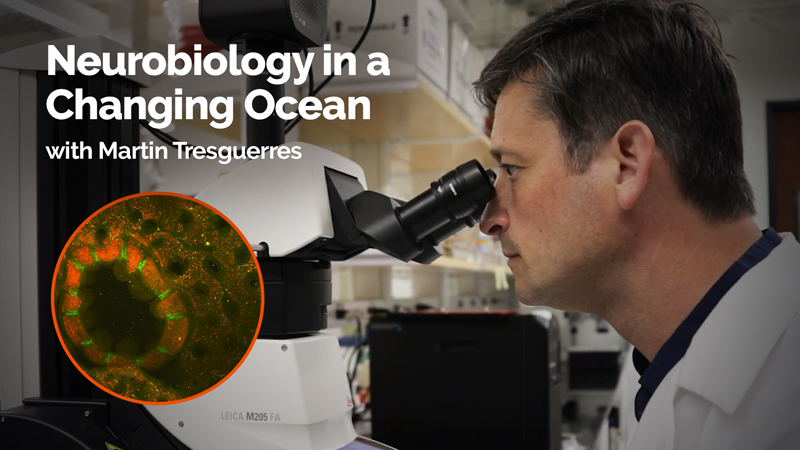
Climate change is reshaping ocean environments through warming, acidification, low oxygen and other pressures. For marine animals, understanding the consequences means looking closely at the systems that connect them to their surroundings.
In this program, Scripps Institution of Oceanography marine biology professor Martin Tresguerres introduces the Allen Discovery Center for Neurobiology in Changing Environments, or ADC-NiCE. The project brings together 13 labs which focus on how changing conditions affect the nervous systems of marine animals.
“The nervous system really is the interface between animals and their environment,” says Tresguerres.
Researchers are studying four very different organisms: coral, snails, sea urchins and stickleback fish. By examining genes and cells, neural activity, physiology, behavior and population genomics, the team hopes to understand how these animals function in naturally variable environments, and what happens when human-driven climate change adds new stress.
The work also has practical goals. Researchers are developing tools for organisms that have not traditionally been studied in the same detail as common biomedical models, while looking for biological differences that may help some populations cope with changing conditions.
Coral restoration offers one example. Coral larvae must find suitable places to settle and grow, yet much remains unknown about how they sense those environments.
“If we can improve coral recruitment by just a minimum amount, the chances of helping with coral reef restoration are huge,” says Tresguerres.
Ultimately, ADC-NiCE aims to turn a deeper understanding of marine neurobiology into information that can support conservation strategies, interventions, public management and policymaking.
Watch: Neurobiology in a Changing Ocean with Martin Tresguerres