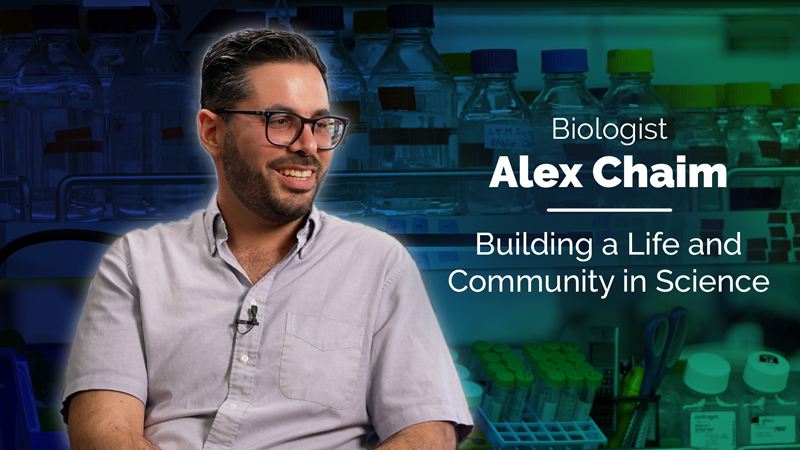
A career in science is built on more than experiments. It can also depend on mentorship, persistence, community and the willingness to keep going when things do not work the first time.
In this program, Alex Chaim, principal investigator of the Chaim Lab and assistant professor of cell and developmental biology at UC San Diego, reflects on the path that brought him from Caracas, Venezuela, to a career in research and teaching. His scientific work focuses on RNA damage and whether it may contribute to diseases associated with oxidative stress, including neurodegenerative disease.
Chaim also talks about the people who shaped him along the way. Mentors helped influence how he now runs his own laboratory, where he tries to give researchers room to take ownership of their projects while providing the support they need. In the classroom, he takes a similarly human approach, helping students see science as something done by people rather than as a collection of facts to memorize.
That sense of connection extends beyond the lab. Chaim helped create CaSAS, a Spanish-language science seminar series designed to give people a place to discuss scientific ideas in Spanish. For some participants, that also means gaining the vocabulary to explain their work to family members and communities outside the university.
His advice to students is practical: seek out research experience, find good mentors and do not be discouraged when an opportunity does not appear immediately. Science, he explains, involves repeated failure, adjustment and trying again. Learning to work through that process can be as important as any individual result.
Watch: Alex Chaim: Building a Life and Community in Science.